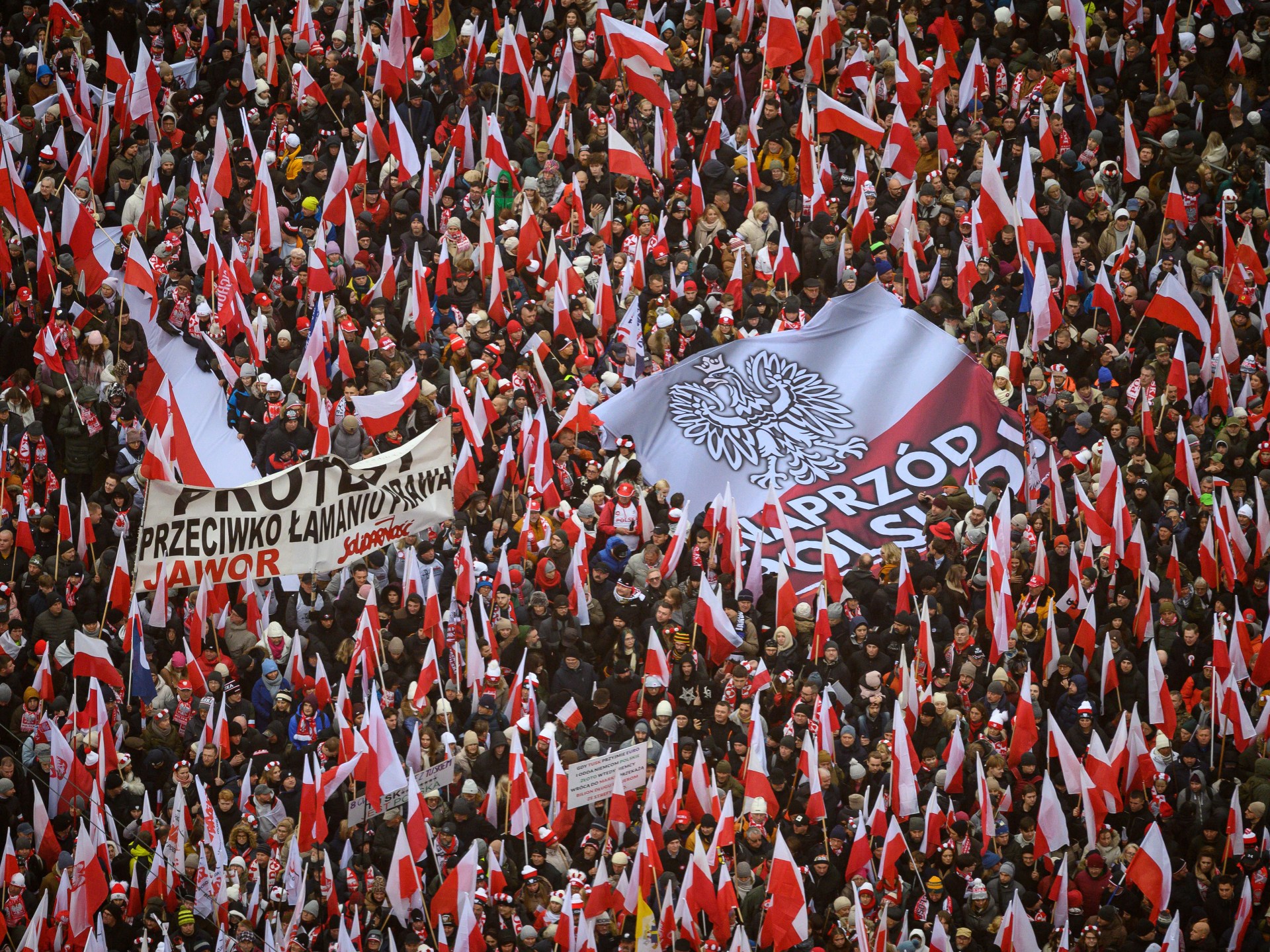
Tens of thousands of nationalists participated in an annual Independence Day march in Warsaw on Wednesday, commemorating the end of Poland's partition and expressing their pride for the nation. The event, which has been a source of tension between right-wing groups and centrists, was attended by Poland's conservative-nationalist President Karol Nawrocki, who criticized the centrist government while speaking at the march.
The gathering took place just days after a deadly shooting in Krakow that left six people dead and over a dozen injured, an incident that has raised concerns about far-right ideology in Poland. Polish Prime Minister Donald Tusk called for restraint amidst heightened political divisions and urged unity, stating that anyone who truly cares about the country must understand that independence, freedom, and a secure Republic are common goods.
The annual march, which began in 1918, has faced criticism for its anti-Semitic and anti-immigration rhetoric, but organizers expect a record turnout this year, with foreign nationalists set to attend from Spain's Revuelta youth movement and Hungary's far-right Mi Hazank party. According to reports, the 24-year-old gunman who carried out the Krakow attack was allegedly interested in neo-Nazi ideologies, such as those espoused by Anders Behring Breivik, who killed 77 people in Norway in 2011.
In the aftermath of a deadly shooting in Krakow that left six people dead and over a dozen injured, Polish Prime Minister Donald Tusk has appealed for restraint amidst rising political tensions. The gunman, who was shot by police officers and later died in a hospital, allegedly had ties to far-right ideologies, according to the Justice Minister Waldemar Zurek.
Tens of thousands of nationalists gathered in Warsaw on Wednesday for an annual Independence Day march, commemorating the end of over 100 years of partition by Russia, Prussia, and Austria. The event, which has been a source of tension between right-wing groups and centrists, attracted a record turnout this year, with foreign nationalists set to attend from Spain's Revuelta youth movement and Hungary's far-right Mi Hazank party.
The march, held under the motto “A Pole is the host in Poland”, has been criticized for its anti-Semitic and anti-immigration rhetoric, but supporters argue that it is an expression of national pride. Poland’s conservative-nationalist President Karol Nawrocki was seen attending the march, where he expressed his disapproval of the centrist government.
Just days after a deadly shooting in Krakow that left six people dead and over a dozen injured, Poland is grappling with rising political tensions. The gunman, who was shot by police officers and later died in a hospital, allegedly had ties to far-right ideologies, according to the Justice Minister Waldemar Zurek.
Tens of thousands of nationalists gathered in Warsaw on Wednesday for an annual Independence Day march, commemorating the end of over 100 years of partition by Russia, Prussia, and Austria. The event has been a source of tension between right-wing groups and centrists, but organizers expect a record turnout this year, with foreign nationalists set to attend from Spain's Revuelta youth movement and Hungary's far-right Mi Hazank party.
The march, held under the motto “A Pole is the host in Poland”, has been criticized for its anti-Semitic and anti-immigration rhetoric, but supporters argue that it is an expression of national pride. Poland’s conservative-nationalist President Karol Nawrocki was seen attending the march, where he expressed his disapproval of the centrist government. Polish Prime Minister Donald Tusk has called for restraint amidst these tensions and urged unity, stating that anyone who truly cares about the country must understand that independence, freedom, and a secure Republic are common goods.