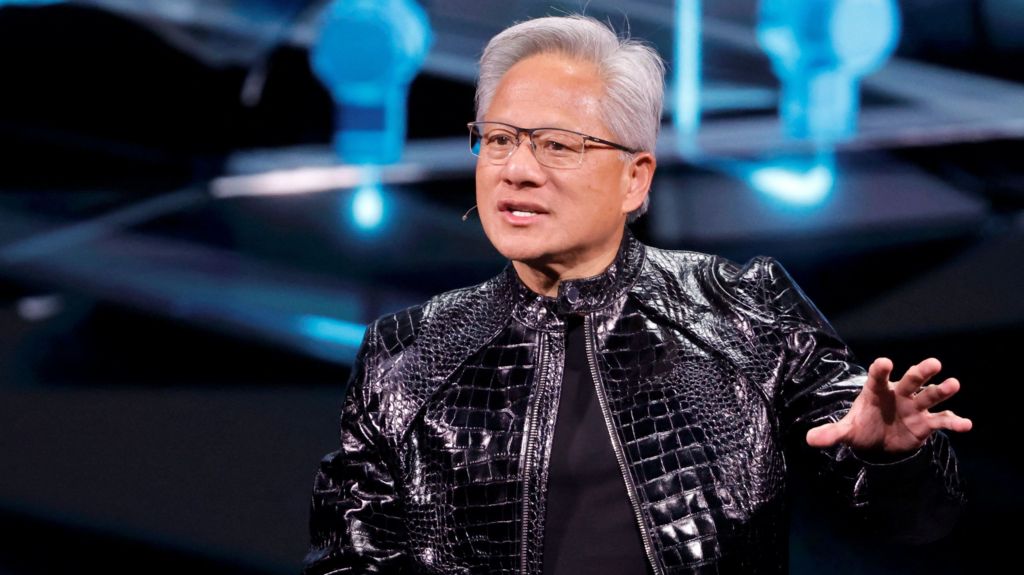
Jensen Huang, the charismatic CEO of tech giant Nvidia, shares his views on artificial intelligence (AI), China, and national security in an interview with Faisal Islam. Reminiscent of Steve Jobs, Huang is at the forefront of AI innovation, with his company's powerful microchips, such as Gracehopper, Vera, and Rubin, being integral to the development of AI models worldwide. During a meeting in September 2019, Huang advocated for lifting export bans on high-performing AI chips, including the H200, during US President Donald Trump's state visit to the UK. Despite concerns raised by national security circles about the zero-sum race towards advanced AI systems, Huang contends that it is possible for both the US and China to win without compromising each other's advancement. He also argues that the world, including China, would benefit from dependence on US technology, with Nvidia chips at its core. As of now, Huang is under investigation over national security concerns and alleged Chinese espionage, yet he has publicly argued for export ban lifts and maintained that his technology is not a national security concern. Nvidia, the epicenter of the US AI tech boom, is still worth more than $4 trillion despite recent market fluctuations.
SECOND PARAGRAPH:
The interview with Huang took place in September 2019, during a time when he was actively lobbying for the lifting of export bans on high-performance AI chips to China. He seemed confident that he had persuaded President Trump of his case, stating that both superpower leaders were interested in their respective countries winning without hindering each other's progress. However, national security experts are skeptical about Huang's stance on the zero-sum race for advanced AI systems and believe that the West, particularly the US, needs to take critical measures to prevent Chinese advancement.
THIRD PARAGRAPH:
In addition to his arguments about the non-zero-sum nature of the AI race, Huang also made a case for the benefits of global dependence on US technology. He claimed that President Trump was clear-eyed about computing technology not being a national security concern and that militaries should build their capabilities on indigenous technology rather than relying on adversaries' technology. Despite these statements, Huang is currently under investigation over national security concerns and allegations of Chinese espionage, raising questions about the potential security risks associated with his technology in China's hands.
FOURTH PARAGRAPH:
Nvidia, a key player in the AI tech boom, is still expected to remain financially sound even if the industry experiences a downturn. With actual hard revenues of approximately $400 billion this year and a market capitalization of over $4 trillion, Nvidia continues to be a major force in the global race for AI supremacy. However, recent market fluctuations reflect new and extraordinary risks at the intersection of technology and global politics, underscoring the complexities surrounding AI development and its potential national security implications.